
When the Weight Becomes Unbearable: A Note on Showing Up
On carrying what we cannot fix, and serving where we can

“The work of care does not stop when the world breaks. It begins there.”
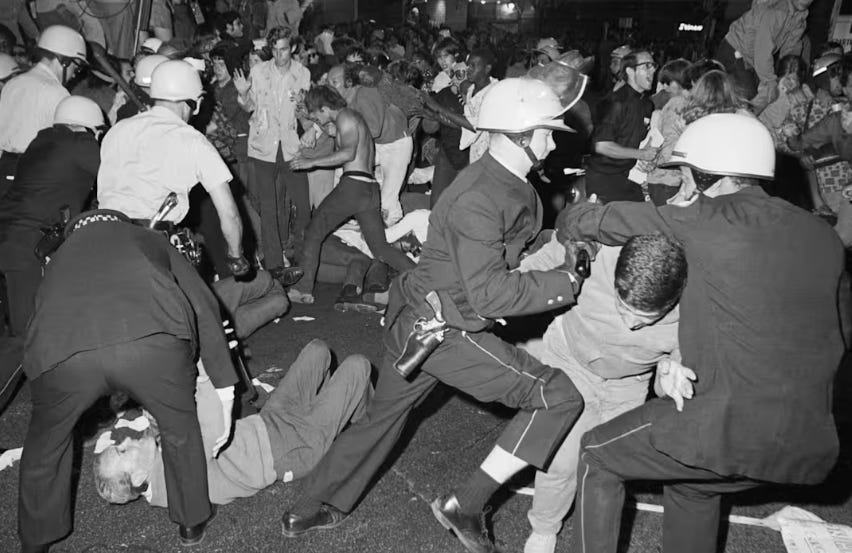
Police and demonstrators in a melee near the Conrad Hilton Hotel on Chicago’s Michigan Avenue August 28th during the Democratic National Convention.
Bettmann Archive / Getty Images
These past few weeks have been hard. The weight of it shows up in the clinic in unexpected ways—a nurse receiving treatment for resected breast cancer dissolves into tears when I ask how she’s doing. Not because of her scan results. Because she cannot stop seeing the images of the VA ICU nurse shot in the street, a colleague doing the same work she does. A patient apologizes mid-sentence for losing her train of thought. Her family member was picked up in a raid yesterday, and she doesn’t know where they took him. A fellow physician sits across from me at lunch and says quietly, “I don’t know how much longer I can do this.”
I need to say this plainly: it is okay to not be okay right now.
We are trained to compartmentalize. To be strong, to project competence, to keep moving through the day, no matter what is happening outside the hospital walls. But strength does not mean pretending the weight isn’t there. It means acknowledging it and then figuring out how to carry it together.
The Examination Room as Witness
Cancer is its own universe of terror and uncertainty, but lately I find myself noticing everything else my patients carry into the room with them. The rent they cannot pay. Children they fear for. Communities that feel like they are fracturing in real time. Jobs that disappeared. Relationships that buckled under the pressure of too much for too long. And still they come to their appointments. Still, they ask me to explain their lab results, to adjust their anti-nausea medications, to tell them whether there is hope. They are showing up for the hard work of staying alive in a body that is fighting them, in a world that feels like it is fighting them, too.
If they can show up, so can we.
I see the cancer floor nurse jogging from room to room, balancing five patients at once—the woman who needs chemo for her AML, her neighbor who needs two units of blood stat, the family next door with a dying family member who needs a carafe of coffee and a Chaplain, and someone to tell them it’s okay to cry. I see the infusion nurse who has to catch her breath and wipe her tears after a traumatic rapid response, then walk twenty feet to the next bay to hang that same drug for another patient. I see the physician answering patient messages before breakfast, writing notes until midnight, showing up to the bedside with the same careful attention she gave ten years ago, even though the administrative burden has grown exponentially.
You are not failing because you feel exhausted. You are human because you do.
We Have Been Here Before
In 1968, this country was on fire. The Vietnam War was tearing communities apart. Martin Luther King Jr. and Robert F. Kennedy were assassinated within months of each other. Cities burned. The Democratic National Convention in Chicago devolved into chaos and violence. Richard Nixon won the presidency on a campaign of “law and order,” and the nation seemed irreparably fractured along lines of race, class, and generation.
Medical students and physicians found themselves caught in the middle. Some treated protestors beaten by police. Others served in Vietnam, patching together soldiers while questioning the war itself. Many felt the same paralysis we feel now—the sense that the scale of the crisis was beyond anything medicine could address. What could a stethoscope do against the machinery of war, systemic racism, and political division?
They kept showing up anyway. Treated the wounds they could reach. Cared for the dying with the same diligence they brought to the curable, because dignity does not require a political position—it requires presence. By the mid-1970s, the country had begun to find its footing again, not because the problems disappeared but because enough people refused to give up on the work of repair.
The arc of the moral universe is long, Dr. King reminded us, and it bends toward justice. But it does not bend by itself.
I keep thinking about the physicians and nurses who worked in Washington, D.C., the night Martin Luther King Jr. was assassinated. The city erupted. Buildings burned. National Guard troops occupied street corners. And in the middle of it all, Howard University Hospital stayed open. Healthcare workers reported for duty even as neighborhoods around them were in flames. They treated gunshot wounds, smoke inhalation, and injuries from the riots. They also treated heart attacks and delivered babies and cared for patients with pneumonia—because those emergencies did not stop just because the city was burning.
Years later, some of those physicians and nurses talked about that week. What stayed with them was not the chaos or the fear. It was how clearly they saw their purpose. When everything else felt impossible, they knew what to do: care for the person in front of them. They could not stop the riots. Could not bring Dr. King back. Could not heal the fractures in American society. But they could suture a laceration. Hold a newborn. Sit with a frightened patient and tell them they are not alone.
The work before them was enough. It had to be.
What We Owe Each Other
In oncology, I have learned something essential: you cannot take away someone’s suffering, but you can refuse to let them suffer alone. The same is true beyond the exam room.
We are living through a time of profound division. People I respect deeply hold positions I cannot reconcile. Communities I care about are in conflict. Real harms are being done, real injustices unfolding, real reasons for anger and fear. But underneath all of it, we are still bound to each other—the physician and the patient, the nurse and the family, the neighbor and the stranger. We do not get to choose the historical moment we live through, but we do get to choose how we meet it.
I am proud to be one of you. Proud to share these burdens with people who keep showing up when the work gets harder, the days longer, the hurts deeper. Who still see the patient in front of them as a person rather than a problem. Those who have not let the brokenness of the system break their capacity for compassion.
I think about the floor nurse I saw last week in the hallway at shift change, leaning against the wall with her eyes closed for just a moment before she went back in. The nurse navigator who stayed an extra hour because her patient’s daughter was driving in and needed to hear the treatment plan directly.
The work we are doing—the unsexy, exhausting, often invisible work of care—is holy work, even when it feels like we are barely keeping our heads above water.
The Weight We Carry
But here is what I also need you to hear: the world is asking too much of you right now.
Your patients need you. Your institution needs you. Your colleagues need you. And somewhere in the background, the news is an endless scroll of catastrophe—another shooting, another raid, another institution crumbling.
You may turn it off.
I mean this literally. The doomscrolling at midnight, the compulsive refreshing of news sites between patients, the cable news running in the background while you eat dinner alone because you’re too tired to cook anything that requires actual attention—you are allowed to stop. You are allowed to close the laptop after your shift instead of reading every new catastrophe. To trade cable news for a novel you’ve been meaning to read, for music that has nothing to do with productivity, for the kind of beautiful waste of time that feels restorative.
Last night, after a particularly long and heavy day, my wife gave me space. It’s not like me to even turn on the TV, much less to sit there quietly watching the old animated version of Beauty and the Beast. Simpler days, maybe. Or just the kind of empty comfort that sometimes you need more than analysis or answers.
This is not ignorance. This is recognizing that you cannot give from a place of depletion, that protecting your mind from the constant assault of information you cannot act on is not weakness but wisdom.
You are already giving everything you have to the people in front of you. I see it in the way you pause before entering a room to compose yourself, even though you just got difficult news about your own health. In how you explain a complex treatment decision for the third time, patiently, because the patient’s son just flew in and needs to hear it too. In your willingness to stay late to call the patient who you know will be anxious about their scan results, even though it means you’ll hit traffic on the way home and miss dinner with your own family again.
The weight of every injustice, every tragedy, every political battle need not rest on your shoulders alongside the weight of your patients’ suffering. You are allowed to be human. To sleep when you can—actual restorative sleep. To eat something that isn’t from a vending machine or grabbed between patients. To move your body in ways that feel good instead of punishing, to remember what it feels like to inhabit yourself without pain or exhaustion or the constant low-grade anxiety that has become your baseline.
You are allowed to talk to someone who loves you and tell them the truth about how hard this is. To say no to the extra committee, the additional shift, the favor that will cost you the last hour of your week that wasn’t already spoken for. To remember that rest is not a luxury—it is the foundation of every act of care you will give tomorrow.
We need you for the long haul, and the long haul requires you to be whole.
The Work in Front of Us
We are being asked now to do what those physicians and nurses did in 1968—to trust that the small acts accumulate, to believe that showing up matters even when we cannot see the outcome, to remember that the future is built not by grand gestures but by the daily decision to care for the person in front of us.
The world feels heavy right now, and you are allowed to say that out loud. You are allowed to grieve what is being lost, to rage at what is being done, to fear what might come next. You are also allowed to step back from the weight when you need to breathe.
This is where community becomes everything. The colleague who offers to help. The friend who checks in. The people who see you and don’t look away. Lean into it. Reach out to the people around you who are struggling, and let them reach you, too. Accept help when it is offered, even when every instinct tells you that you should be strong enough to handle this yourself. Admit when you are at your limit, because that limit is real, and ignoring it will not make it disappear.
Vulnerability is not failure. It is the price of caring deeply in a world that asks too much, and it is also the bridge that connects us to one another when we need it most.
You are seen. You are valued. What you do matters more than you will ever fully know. We will get through this—not unscathed, but together. And in the meantime, take care of your heart, take care of your mind, take care of your body.
You cannot heal the world if you are broken.
If you are struggling, reach out to a friend, a colleague, a therapist, a crisis line, anyone. You do not have to carry this alone.
A much needed and thoughtful essay. Thank you, Dr. Doug.
A beautiful essay and a balm for every reader. Thank you.