
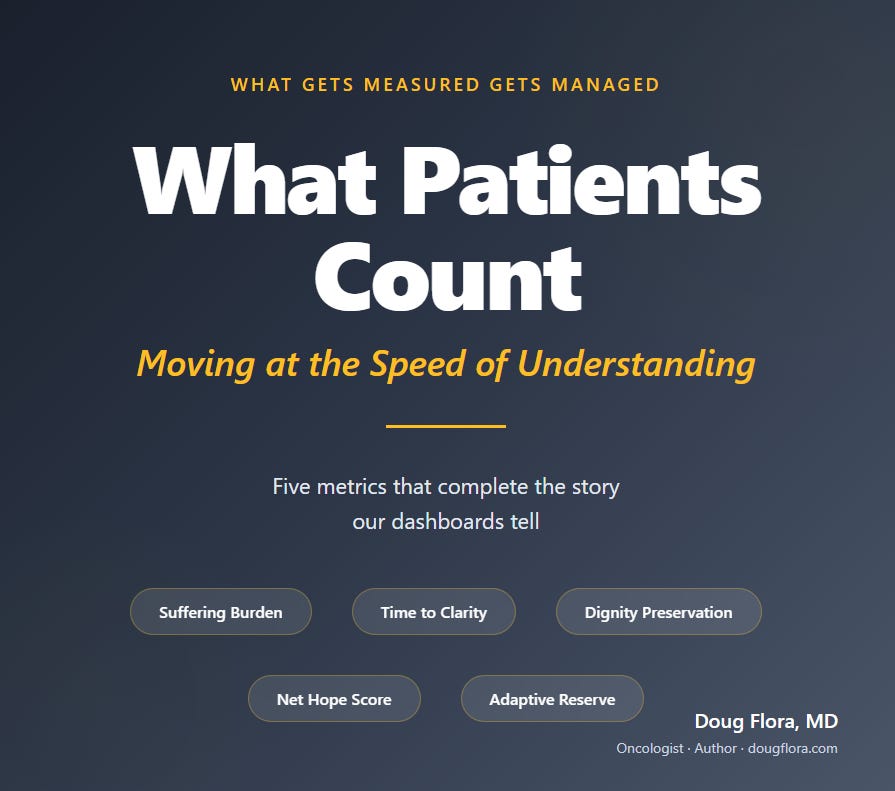
What Patients Count
What we measure in cancer care—and what we should

"Speed without comprehension creates noise. Clarity creates ground to stand on."
Most cancer center dashboards tell the same story. Throughput. Margins. Door-to-needle times. Patient satisfaction scores that keep accreditation bodies satisfied and payers willing to reimburse. These numbers matter—they keep institutions alive, catch problems before they metastasize through systems, and protect patients in ways that are real even if invisible.
But after my own diagnosis, I understood something I had suspected for years: there is a whole category of metrics that rarely make it to leadership dashboards. The ones patients experience viscerally but cannot quite name. The ones that determine whether care feels humane or merely efficient, whether suffering gets noticed or ignored.
Last week, I asked you guys a question. Not about five-year survival or quality metrics, but about what else we should measure. What patients carry that never shows up on our slides.
The responses arrived not as complaints but as careful observations—from patients, caregivers, advocates, clinicians who live this work daily. What emerged was not a wish list. It was a blueprint for completing the story our dashboards tell. Metrics that, if tracked with the same rigor we bring to tumor markers and treatment timelines, might change what cancer care feels like.
I call these The Other KPIs (Key Performance Indicators)
Medicine has learned to count one kind of suffering. Toxicity gets graded on standardized scales. Complications get documented in structured notes. Adverse events trigger quality reviews and incident reports. What shows up in physiology, we measure.
The other kind—what seeps into waiting rooms and accumulates across the long stretches between appointments, what builds in financial statements and erodes in family structures—we have not learned to count at all.
Suffering is not only pain. It is the exhaustion of not knowing what comes next, the quiet fear of becoming a burden to the people you love most, the financial anxiety that compounds during treatment like interest on an unwanted loan. It is the sense that life is narrowing without your consent, that control is slipping away one appointment at a time.
Often invisible to systems. Never invisible to patients.
I have seen this from both sides now. As an oncologist, I could sense it—the weight in a patient’s posture, the way eye contact shifted when discussing next steps, the slight delay before answering “How are you managing?” As a patient, I lived through that accumulation. The fatigue was not just physical. The uncertainty was not just about scans. There was a cumulative burden that standard assessments never captured, that no one seemed to have language for.
This is what I mean by Suffering Burden: the cumulative weight of physical discomfort, emotional distress, and financial strain that patients carry through care. It affects everything—adherence to treatment, quality of life, even survival—but it rarely appears on the same dashboard as clinical outcomes.
It should. Because it directly affects those outcomes.
The infrastructure to measure this already exists. Patient-reported outcomes designed thoughtfully rather than as checkbox exercises. Navigation touchpoints placed strategically rather than reactively. Financial counseling is offered early, before a crisis, when intervention can still prevent a catastrophe. Technology that flags accumulating burden, the way it flags rising creatinine or dropping blood counts.
Not revolutionary. Intentional.
Cancer strips control with remarkable efficiency. Appointments get scheduled for you. Decisions arrive pre-shaped by protocol and insurance formularies. Time compresses. Language becomes foreign even to the educated, a clinical shorthand that excludes the very people it is meant to serve.
Most losses of dignity are not dramatic. They are procedural.
Did anyone explain what would happen before it happened? Were you offered a genuine choice between reasonable paths, or merely asked to consent to a plan already finalized? Did someone notice when medical shorthand replaced plain speech, when your confusion became visible, and shift their language accordingly?
Courtesy alone does not protect dignity. Explanation does. Choice does. Time—however brief—does.
These moments can be designed into workflows rather than left to chance or individual heroism. The moment before a procedure, when someone tells you what you will feel and why. When your oncologist presents options rather than instructions, trusts you enough to navigate uncertainty together. When a nurse notices that you do not understand and explains again without making you feel small for asking.
I remember the appointments where my dignity remained intact. My oncologist would pull up my scans before I sat down, knew exactly where we had left off, and had already thought through the implications of my latest results. There was no hurry to perform efficiently. We moved at the speed of understanding.
And I remember the other kind. Where I had to re-explain my entire history to someone reading it for the first time while I sat there. Where questions were answered, but comprehension was never confirmed. Where I left the room less certain than I had arrived, my dignity eroded not by cruelty but by systems designed for throughput rather than human exchange.
Same disease. Same institution. Different dignity scores.
What if Dignity Preservation were tracked the way we track wait times? Not with surveillance but with commitment. Not measuring to punish but measuring to improve, to notice when workflows inadvertently strip agency from people already struggling to maintain it.
Patients would notice. Families would carry it forward. Clinicians would feel it too—the restoration of what drew many of them to medicine in the first place.
Electronic health records track cycle times with remarkable precision. Door to doctor. Order to result. Diagnosis to treatment start. These metrics catch bottlenecks, expose inefficiencies, and improve access in ways that are genuinely valuable.
But there is another kind of time they do not measure at all.
Few experiences in cancer are as destabilizing as waiting without understanding. Results are posted to patient portals at 2 AM, before anyone explains what they mean. Plans get delayed by insurance reviews or scheduling conflicts, and silence fills the space where communication should be. Patients live in informational limbo while systems move at their own bureaucratic pace.
Fear fills those gaps. A lot of fear.
Patients understand this. The pathology report that appears in their portal with findings they cannot understand, technical language at best half-understood, and implications they can only guess at. Seventy-two hours passed before someone called to explain. Seventy-two hours is a long time to live inside your own worst interpretations.
Traditional KPIs measure velocity—how quickly the biopsy was performed and how quickly the pathology report was completed. They do not measure comprehension. Let’s add a new metric called Time to Clarity. The gap between “results ready” and “patient understands what this means for me” can last hours, days, sometimes weeks. A portal message with tumor markers is information. A phone call explaining what those numbers mean for treatment is clarity.
Speed without comprehension creates noise. Clarity creates ground to stand on.
This gap is solvable. Pre-visit summaries that prepare patients for what they will hear rather than ambushing them with complexity. Same-day results calls with built-in time for explanation and questions. Navigators who bridge the silence between appointments, who check in not to gather data but to ensure understanding remains intact.
Technology designed for comprehension rather than mere data transfer. Follow-up that verifies whether patients actually understood, not just whether they logged into the portal.
The real work is cultural—deciding that clarity is not a luxury reserved for ideal circumstances but baseline care, as fundamental as sterile technique or informed consent.
Cancer centers measure patient satisfaction with an almost religious devotion. Press Ganey scores. Star ratings. “Would you recommend us to family or friends?” These metrics capture something real about service quality and operational excellence.
But what if we asked different questions?
Not “would you recommend us” but “do you feel guided through this? Do you feel held by this team or processed by this system?”
Not “how satisfied are you” but “do you know who to call when you are scared at 2 AM and cannot sleep?”
Not “rate your experience” but “does someone here remember your name without checking the chart? Your story? What you are most afraid of?”
Those questions would tell us something worth knowing. Give us something worth improving.
Hope is not inspirational posters in waiting rooms or encouraging phrases in discharge instructions. Hope is system behavior made visible.
Continuity. The same oncologist who remembers what you discussed at your last visit without you having to repeat yourself. The same nurse navigator who answers when you call, whose voice has become familiar. A phone number that connects to a human rather than routing to voicemail, which may or may not be checked.
Competence made transparent. Plans are explained clearly before you have to ask. Next steps are outlined while you are still in the room rather than left vague for you to puzzle out later. Clinicians who admit “I do not know” when they do not, then find out and call you back, demonstrating that your question mattered enough to pursue.
Presence. Someone who looks up from the computer screen, who does not rush the moment when you finally ask the question you have been carrying for days, whose body language signals that this conversation matters more than whatever comes next on their schedule.
Hope scales. It does not require heroic individuals working unsustainable hours. It requires reliable systems—workflows designed to protect continuity, staffing models that enable presence, and technology that supports rather than fragments the therapeutic relationship.
Net Hope Score turns out to be measurable. Improvable. Designable. We simply have to decide that it matters enough to track alongside the metrics that keep our organizations solvent.
Oncology has gotten remarkably good at measuring disease. Tumor markers guide treatment decisions. Response rates predict outcomes. Progression-free survival determines when to switch therapies. These measurements form the scientific foundation of everything we do.
But there is another kind of measurement we rarely attempt—one that matters just as much. I’ll call this KPI Adaptive Reserve.
Every oncologist has seen it. The patient who says “I’m fine” while their hands shake. The caregiver who insists, “We’re managing,” while visibly unraveling. The family that nods understanding while terror fills every silence.
We chart weight, performance status, and pain on a scale of 1 to 10. We do not chart the ratio of terror to determination, of grief to hope. We do not measure what cancer care demands against what patients actually have left to give.
This matters because cancer makes enormous asks. Physical endurance through treatment that was designed to be tolerable, but often is not. Cognitive capacity to understand options when your mind is foggy from fear, medication, or sleepless nights. Emotional resilience through uncertainty that never quite resolves. Financial stability is under pressure, and the pressure is compounding. Social support that does not collapse even when support systems are already strained.
Most patients say yes to all of it. Even when their adaptive reserve is nearly gone.
“I’m fine” is often the least truthful thing a cancer patient says. Not because they are lying but because they are performing—the expected reassurance, the brave face, the strength they think we need to see to keep treating them. Or because they genuinely cannot assess their own reserve, do not know how to name what is depleting.
The real question: how much adaptive reserve remains? What happens when the next hard thing arrives—and in cancer, it always does?
This is measurable. Not with the precision we bring to tumor markers, but meaningfully enough to guide intervention. Regular check-ins designed to surface truth rather than extract reassurance. Validated screening tools for distress, for financial toxicity, for caregiver burden. Clinical intuition given permission to override what patients report, to notice what performance conceals.
Technology can help. Patient-reported outcomes that track trends rather than snapshots, that flag depletion before crisis. Predictive models trained to recognize when reserve is running low.
But the real work is cultural. Creating space for patients to stop performing. To admit they are not fine, that reserves are depleting, without fear that treatment will be withdrawn or judgment will follow. To ask for help before they break.
What if adaptive reserve appeared in treatment planning discussions not as soft data but as essential information, as clinically relevant as cardiac function or renal clearance? What if depleted reserve triggered intervention the way depleted blood counts do—with urgency, with resources, with the understanding that this threatens outcomes just as surely as disease progression?
These Other KPIs will not replace the metrics that keep cancer centers financially viable. They should not. Financial sustainability matters. Clinical quality matters. Operational efficiency keeps doors open, staff employed, and treatments accessible.
But so does whether care feels human. Whether patients feel held through the worst experience of their lives. Whether suffering is addressed before it escalates into a crisis that is harder and more expensive to address.
The tools to measure these things already exist. Patient-reported outcomes. Validated screening instruments. Predictive analytics that can spot patterns clinicians miss. Clinical intuition given permission to override performance metrics when necessary.
What we lack is not capability. It is commitment.
This is where teams come in. Where leadership matters. Where culture shifts from aspiration to practice.
Start somewhere. Pick one Other KPI that resonates with your organization’s stated mission. Suffering Burden for a center that claims to focus on whole-person care. Time to Clarity for a system that has invested heavily in patient experience. Net Hope Score for a community cancer center where relationships have always mattered more than the dashboards acknowledged. Adaptive Reserve for any place that treats human beings rather than disease processes.
Build the infrastructure to measure it. Not perfectly—perfect is often the enemy of meaningful. But consistently. With the same seriousness of purpose you bring to quality metrics and financial targets.
Monthly team huddles where you review this data as you would complications and near-misses. Case discussions where depleted adaptive reserve receives the same attention as abnormal laboratory values. Leadership dashboards where dignity and hope and clarity appear alongside throughput and margins, where the mission gets represented in metrics rather than merely stated in values documents.
Create accountability, but not the punitive kind that makes people defensive. The constructive kind that names problems so they can be solved. When Time to Clarity lengthens, investigate why—is it staffing, is it technology, is it culture? When Suffering Burden accumulates in certain populations or service lines, intervene before crisis becomes the norm. When Net Hope Score drops, ask what broke in the system, what relationship or workflow, or reliability patients could once count on that they cannot anymore.
Celebrate improvement the way you celebrate clinical wins. Because these are clinical wins. They predict adherence. They influence quality of life and probably survival, though we have not studied them with the rigor we bring to drug development. They shape whether patients and families look back on cancer care as something that happened to them or something that was done with them, for them, honoring their humanity while fighting their disease.
The most important step: give your teams permission to name what they already see. Clinicians notice these things—the patient who claims to be fine but is not, the family that is unraveling, the burden accumulating that will become catastrophe if left unaddressed. They notice but often lack language to describe what they are observing, worry that naming it will seem soft in cultures that value hard data, or do not trust that systems will act even if they report it.
The Other KPIs provide the language. The structure. The permission to treat these observations as clinically relevant rather than merely anecdotal, to trust that what clinicians sense matters even when it has not been quantified.
When the burden becomes visible, navigation gets deployed before the crisis rather than after. When dignity preservation gets tracked, workflows get redesigned to protect it. When time to clarity matters, communication protocols change. When hope gets measured, continuity gets protected even when it is expensive or inconvenient. When adaptive reserve appears on dashboards, support gets mobilized before catastrophe becomes the only option.
Not perfectly. Not everywhere. But measurably. In ways patients notice and carry forward, in ways clinicians feel as restoration of what drew them to this work.
Hospital and practice leaders operate under extraordinary pressure. Labor shortages seem perpetual. Reimbursement constraints that tighten yearly. Regulatory complexity that consumes resources without obviously improving care. The mission can feel abstract against these concrete demands.
However, the mission still appears every morning. In different clothes than a bedside nurse or attending physician wears, with different responsibilities and pressures, but with the same fundamental purpose. Systems that forget what they exist for do not usually forget dramatically. They forget gradually, one compromise at a time, until throughput becomes the goal rather than the means and metrics become the mission rather than measures of it.
2026 might be the year we decide these Other KPIs are not afterthoughts, nice-to-haves, or things to track only when we have extra resources. They are priorities. Not instead of traditional metrics but alongside them, completing rather than replacing the story our dashboards tell.
Because in the end, traditional KPIs tell us whether organizations survive. They should. We need them to.
The Other KPIs remind us what we are surviving for. What all of this infrastructure, effort, and resource allocation is ultimately meant to serve.
Systems do not just move volume. They shape lives—including the lives of patients who will not survive their cancer despite our best efforts, whose time with us becomes their last chance for care that honors their humanity. When we treat them not as clinical problems to be solved or protocols to be executed, but as whole people navigating suffering, we can ease even when we cannot cure.
That seems worth measuring. Worth building infrastructure around. Worth committing to with the same seriousness we bring to everything else that matters in medicine.
Let’s measure it. Let’s improve it. Let’s shape these systems intentionally rather than letting them shape care by accident or default.
The tools exist. The capability exists. What comes next is choice.
For more on making cancer care more human, visit dougflora.com and check out Rebooting Cancer Care: Can AI Make Cancer Care More Human Again?
We have a “diabetes distress” validated survey, my 25 year old daughter with T1D completes it periodically and I am always horrified at the results each time. This sounds like a neat clinical research project! As if you need more work to do!
You’ve described a systematic way to make all healthcare delivery better by careful measure and pertinent action