
Be a Candle Lighter

“There are two types of people in this world: candle lighters and candle blowers.”
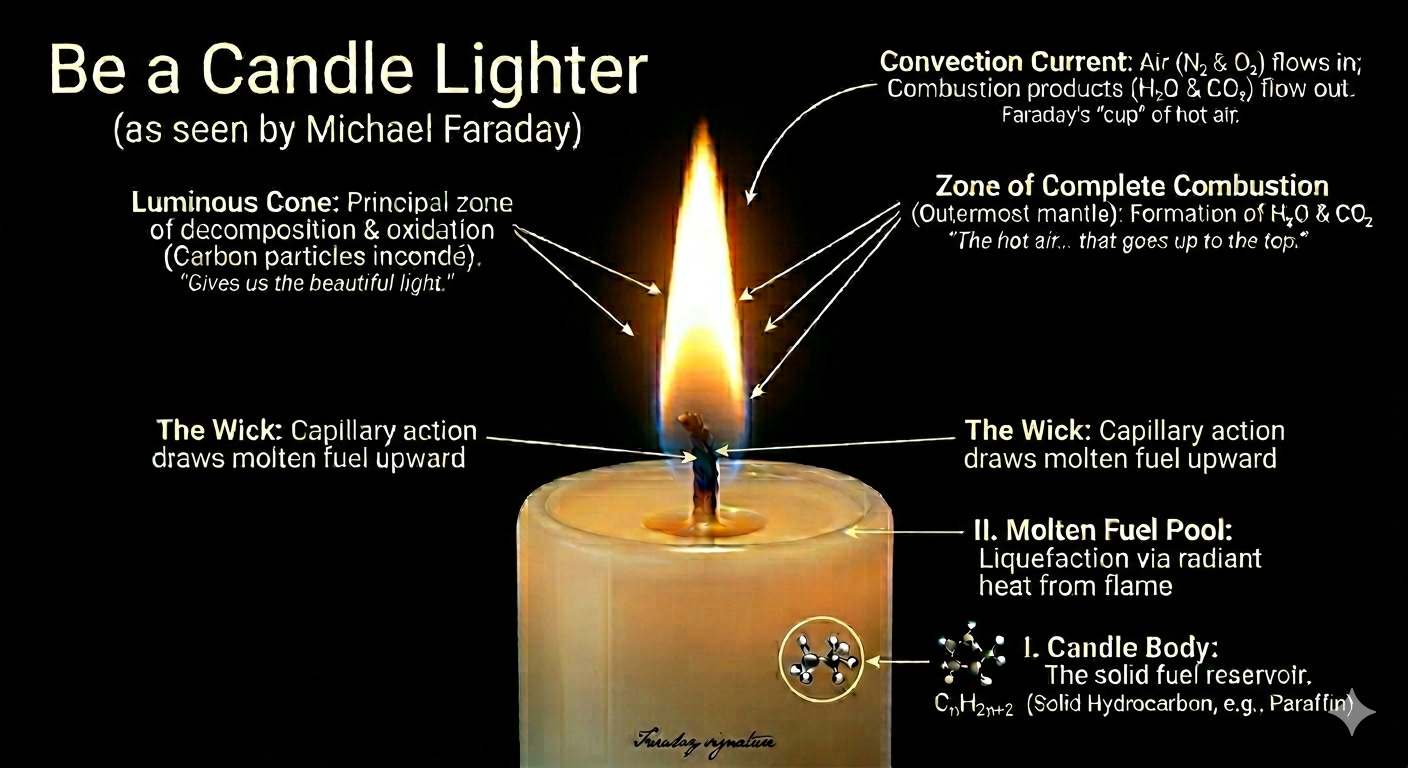
In the winter of 1860, sixty-nine years old and a few months from his last public lecture, Michael Faraday stood at the lectern of the Royal Institution on Albemarle Street in London and held up a candle. He had given some version of this lecture three times across his career; this would be the final time. The hall was packed with children and parents who had come to hear what would later be published as The Chemical History of a Candle. “There is no better, there is no more open door by which you can enter into the study of natural philosophy,” Faraday told them, “than by considering the physical phenomena of a candle.” Then he lit the wick.
What he demonstrated that week, and what generations of physics students have rediscovered since, is that a candle is a small engine of self-sufficiency. The wax does not burn. The wax melts in the warmth of the flame, climbs the wick by capillary action, vaporizes at its tip, and only there meets oxygen at the thin luminous shell we call combustion. The flame is a boundary. It sustains itself for as long as the wick keeps drawing up its own supply.
When you tilt a fresh wick into an existing flame, what crosses the gap is heat. A few calories of thermal energy, enough to bring the new wax to its ignition temperature. The original candle gives up nothing of its substance. Its wick keeps feeding its own flame. Light multiplies; the source is not diminished.
A single candle illuminates poorly. Its intensity falls away by the inverse square of the distance. Place a second across the room and the geometry changes. Shadows soften. Corners that had been black become legible. A third and a fourth do not so much add brightness as redistribute it, until the room itself, rather than any single flame, is what glows. The eye, which registers light logarithmically rather than linearly, experiences the change as something more than addition. It experiences it as warmth.
I thought about Faraday last week at a long dinner table. I had given a keynote that afternoon to one of the country’s largest oncology practices, signed books for a line that wrapped through the lobby, and then sat down to eat with the executive team. Parallel conversations I could only half-follow at any moment, each one a thoughtful exchange about how to improve patient care. People listened the way good clinicians listen. The energy was contagious: smart, generous people who refuse to passively accept hard problems. The room behaved like the physics: no single voice did the lighting, and the brightness belonged to the company.
That kind of table is rarer than it should be. Most of us have sat at the other one, where the most credentialed person has quietly confused finding the flaw with knowing the answer. There is a posture to it. Arms crossed, the small pleasure of explaining why your idea will not work. Caution dresses itself up as wisdom. The idea goes under glass before anyone has tried it. Somewhere downstream, a patient who needed it never learns it existed.
A candle that gives no light to another candle has not preserved itself; it has only delayed the moment its own wick burns out alone. Faraday closed his last Christmas lecture with a wish for his young audience: that they might, in their generation, be fit to compare to a candle, and that their deeds might be honorable and effectual in the discharge of their duty to their fellow men. He died six years later. The lectures are still in print.
The older I get, the more I notice how much of a life comes down to the company you keep. Andrea, who reads what I write at the kitchen counter and tells me, plainly, where the argument actually lives. The friends who answer the late message, read the ragged early draft, and fan the small flame before it goes out. Colleagues scattered across cancer centers I will never set foot in, who pick up the curbside call at nine at night, who keep showing me what becomes possible when good people refuse to quit on hard things, for patients who do not have time for our caution.
I am writing this on the way to another meeting full of them. Another table, the same kind of room. People who came to work today already decided to be lighters. The geometry will hold. Add a flame, then another, then another, and at some point the room itself starts to glow. The physics has not changed since Faraday’s last lecture on Albemarle Street. What changes is whether we keep finding our way to the rooms where the lighters are gathered, and whether, when we get there, we have brought a wick of our own.
Choose the lighters. Keep them close. Watch the room get bright.